TradeFlow ERP Platform
Rice Import/Export Commodity ERP
Overview
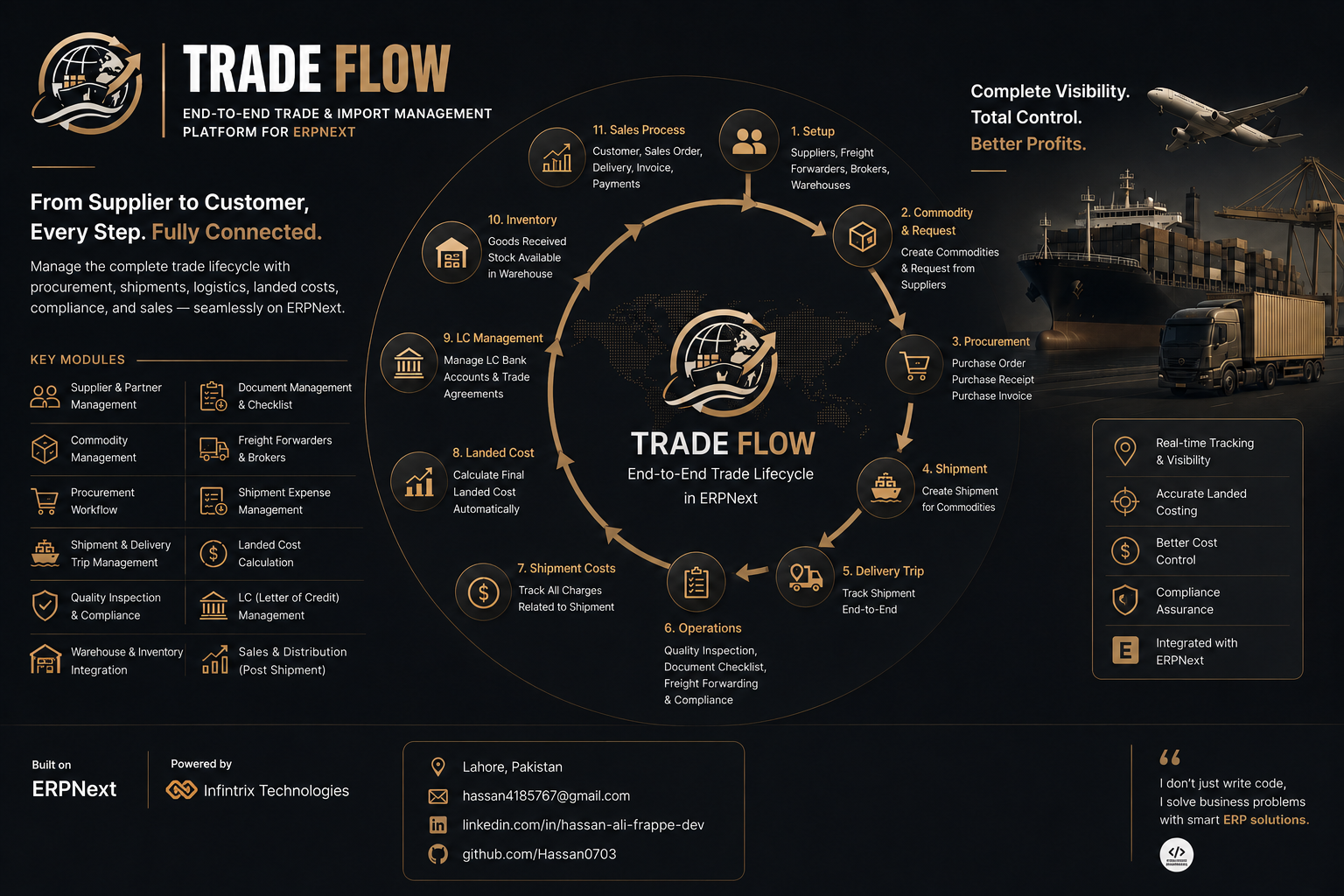
TradeFlow is a comprehensive ERP platform designed for the international rice trade industry. It handles the entire lifecycle from procurement and logistics to inventory management and financial reconciliation.
The Problem
The rice import/export industry relies on fragmented tools — spreadsheets for tracking, separate accounting software, manual communication channels, and paper-based documentation. This leads to delayed shipments, inventory discrepancies, costly errors, and hours of manual data entry. The client needed a unified system that could handle the complexity of international commodity trading while remaining easy to use.
Architecture & Approach
I designed TradeFlow as a modular ERP system on the Frappe framework, extending ERPNext with custom modules specific to commodity trading. The architecture follows a domain-driven design pattern with clear separation between procurement, logistics, inventory, and finance domains. Real-time data synchronization ensures all stakeholders work with the same information.
Technology Stack
Key Features
Procurement Management
End-to-end procurement workflow from supplier onboarding to purchase order generation, quality checks, and payment scheduling.
Logistics & Shipping
Real-time shipment tracking, container management, freight optimization, and customs documentation automation.
Inventory Control
Multi-warehouse inventory with batch tracking, expiry management, and automated reorder points.
Financial Reconciliation
Automated invoice matching, multi-currency support, payment tracking, and financial reporting.
Commodity Pricing
Real-time market price integration, price trend analysis, and automated pricing adjustments.
Analytics Dashboard
Comprehensive dashboards for business intelligence, KPI tracking, and decision support.
Lessons Learned
Deep domain knowledge is essential — understanding the rice trade industry's nuances shaped every architectural decision.
Modular design allows incremental deployment; not every module needs to go live at once.
Real-time data synchronization across distributed teams requires careful cache invalidation and event-driven architecture.
Internationalization and multi-currency support must be designed from day one, not added as an afterthought.